
GRS Audit Checklist for Garment Factories: 4 Chapters with Downloadable Documents

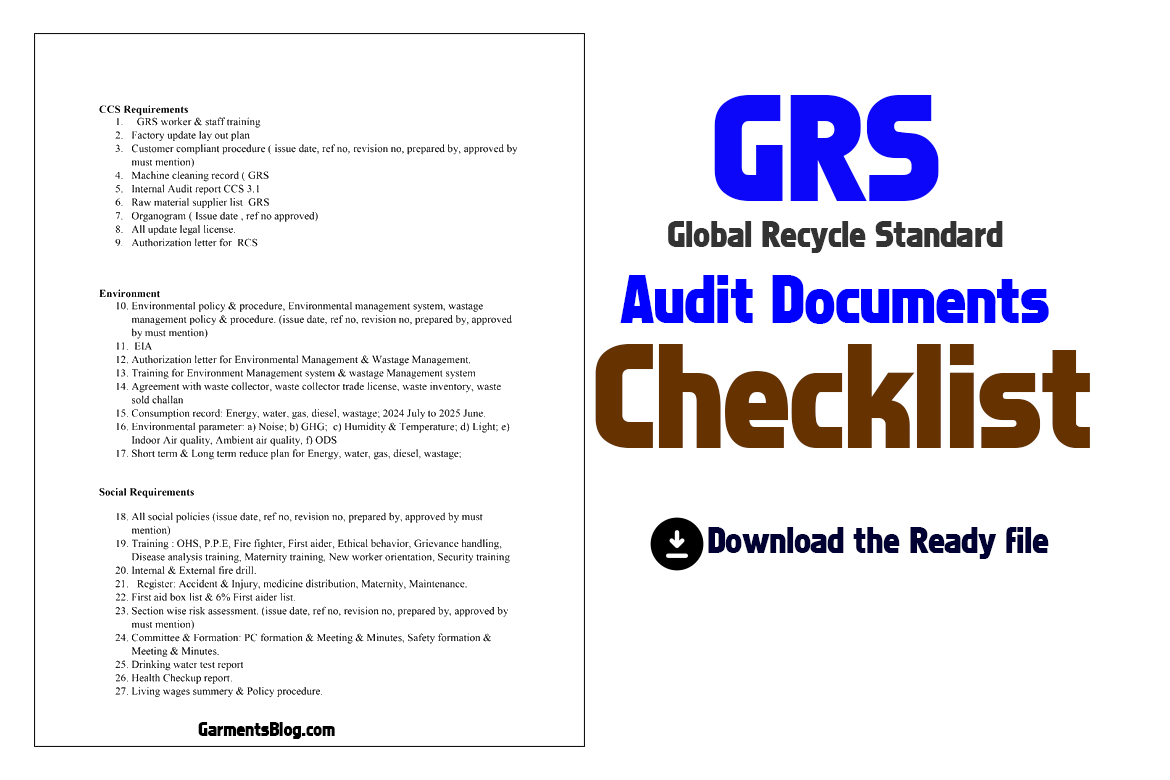
In this blog, I am sharing the comprehensive GRS audit checklist for garment factories to help you prepare properly and implement all required steps to complete the Global Recycled Standard (GRS) audit successfully.
I have also attached the full document list below so you can download the GRS audit document checklist and use it directly in your factory.
There are 4 main types of document requirements for the GRS audit:
- General Requirements
- Environmental Requirements
- Social Requirements
- Technical Requirements
Below, I will explain each part in detail so you can clearly understand what documents you need and how to prepare your garments factory for the GRS audit.
General Requirements of GRS Audit
This section covers the basic requirements needed to understand how well the factory is performing and whether it is truly set up to follow the GRS rules.
Essentially, this is how auditors check: Is the factory and its employees truly prepared for the GRS audit?
To make sure the audit meets all compliance standards, there are a few important documents that must be gathered and ready before the auditor arrives.
GRS General Audit Requirements checklist includes:
- GRS worker & staff training records
- Factory updated layout plan
- Customer complaint procedure (SOP)
- Machine cleaning records
- Internal audit report
- GRS raw material supplier list
- Organizational chart (Organogram)
- All updated legal licenses
- Authorization letter for GRS / RCS
These documents are the first and most basic things needed for the GRS audit checklist. They must be presented right at the start of the opening meeting.
During every GRS (Global Recycled Standard) Audit, the auditor will first verify these documents. This allows the audit process to officially begin and proceed smoothly.
Since these documents are standard for anyone handling an audit, we won’t spend time explaining every single one here. However, we need to focus specifically on the key requirements for the Customer Complaint Procedure and the Organogram.
The factory must have a working system in place to handle any customer complaints. This procedure must follow these standard rules inside its Standard Operating Procedure (SOP):
- Issue Date: The date the document was officially issued and put into effect.
- Reference Number: A unique document tracking number matching the SOP master list.
- Revision Number: Indicates the version or revision history of the document (e.g., Version 1.0, Version 2.0).
- Prepared By: Name and job title of the person who created the document.
- Approved By: Name and job title of the authority who officially approved the procedure.
Inside the Organizational Chart (Organogram) Details
The Organizational Chart must also show its Issue Date (when it was first implemented in the factory). If it has been modified, include the Updated Date or a clear Version Number so it’s easy to track.
Finally, like the procedure above, the chart must clearly specify the name and designation of the person who prepared it and the person who approved it.
Environmental Requirements of GRS Audit
To secure the Environmental section of the GRS Audit, you must make sure the following documents are fully prepared and updated.
These documents are very important for the auditor because they do two things:
- They prove the factory has official environmental rules in place.
- They show that all staff follow and understand those rules in their daily work.
This demonstrates that the factory is fully committed to environmental protection, which is a core pillar of the Global Recycled Standard.
Required Environmental Documents for GRS Audit Checklist:
- Environmental Policy & Procedure, Environmental Management System (EMS), and Waste Management Policy & Procedure
- EIA (Environmental Impact Assessment)
- Authorization Letters for Environmental Management & Waste Management
- Training Records for Environmental Management System and Waste Management
- Waste Collector Agreement, Trade License, Waste Inventory, and Waste Sold Challans
- Consumption Records of Energy, Water, Gas, Diesel, and Waste (July 2024 – June 2025)
- Environmental Parameter Reports:
- a) Noise
- b) GHG (Greenhouse Gas Emissions)
- c) Humidity & Temperature
- d) Light
- e) Indoor & Ambient Air Quality
- f) ODS (Ozone Depleting Substances)
- Short-Term & Long-Term Reduction Plans for Energy, Water, Gas, Diesel, and Waste
EIA (Environmental Impact Assessment)
A professional study that identifies how the factory’s operations affect the environment. It evaluates the impact on air, water, and land, confirming that the factory clearly understands its environmental footprint.
Authorization Letters for Environmental & Waste Management
Official documents that identify the responsible persons who have the authority to manage:
- The Environmental Management System (EMS)
- The Waste Management Process
These letters show who is accountable for each area.
Waste Collector Documentation
This proves the factory works with legal and approved waste handling partners. It includes:
- The signed Waste Collector Agreement/Contract
- The waste collector’s Trade License
- Waste Inventory Logs (daily/monthly records of all waste types and quantities)
- Challans/Receipts for waste that was sold or transferred
This ensures transparency in waste disposal and recycling.
Consumption Records (July 2024 – June 2025)
A detailed record showing how much the factory used:
- Energy
- Water
- Gas
- Diesel
- Total Waste generated
Auditors check these numbers to confirm the factory is tracking its resource consumption accurately.
Environmental Parameter Reports
These are test results from accredited testing labs or internal monitoring systems. They verify that the factory meets environmental safety levels for:
- Noise levels
- GHG (Greenhouse Gas emissions)
- Humidity & Temperature
- Light levels
- Indoor & outdoor air quality
- ODS (Ozone Depleting Substances)
Reduction Plans (Short-Term & Long-Term)
These plans show how the factory will reduce its environmental impact over time. They include measurable goals to lower:
- Energy use
- Water use
- Gas & diesel consumption
- Total waste generation
Short-term plans cover immediate improvements, while long-term plans show the factory’s future roadmap for environmental sustainability.
Social Requirements of GRS Audit
This detailed set of social compliance documents must be presented to the auditor to prove how the factory actively protects the health, safety, and ethical rights of everyone inside the facility. This confirms that the workplace is fair, ethical, and fully follows all rules established for worker well-being.
- All social policies
- Training records: OHS, PPE, Firefighting, First aid, Ethical behavior, Grievance handling, Disease prevention, Maternity care, New worker orientation, and Security training
- Internal & external fire drills
- Registers: Accident & Injury, Medicine distribution, Maternity, and Maintenance
- First aid box checklist & Certified first aiders list (minimum 6% of total workforce)
- Section-wise risk assessment
- Committee formations & meeting minutes: Participation Committee (PC) and Safety Committee
- Drinking water test report
- Health checkup reports
- Living wage summary, policy & procedure
- Grievance register (written & verbal)
- Toilet list with cleanliness checklist
- PPE distribution records
- Personal files: Doctor, Nurse, Electrician, Welfare officer / Maternity care, PC Vice President
- Salary sheets (last 3 months)
- Salary payment forwarding letter to bank
The documents listed in this section are specifically dedicated to fully addressing the social compliance sector of the GRS audit checklist.
The Compliance Team is responsible for presenting these documents to prove that all procedures have been effectively implemented and are actively working inside the factory. This documentation covers every part of the social compliance requirements, ensuring a safe and ethical environment for all workers.
The audit checks all official Policies, detailed Records, required Test Reports, and proof of various Workplace Activities like training and safety drills. This audit even verifies the factory’s commitment to paying workers on time by reviewing the official salary payment information and the forwarding letter associated with those payments to the employees.
Technical Requirements of GRS Audit
We need to pay special attention to technical paperwork because it gives the auditor solid proof that the certified material (like GRS recycled polyester or cotton fiber) was never mixed with any uncertified material.
The papers create a perfect record that lets the auditor follow the material’s entire journey: from when we bought it from the supplier, through every step of making the product in the factory, until the final item was shipped to the customer.
The required technical documents for the GRS audit checklist are given below:
- Traceability Documents:
- Purchase Documents: Commercial Invoice, Packing List, Bill of Lading (BL), Port Challan, Raw Material Payment Proof (e.g., Bill of Entry, Sales Contract, SWIFT Copy).
- Production Documents: Store Issue Requisition (Yarn + Weft), Warping Records, Weaving Logs, Pre-treatment, Dyeing & Finishing Reports.
- Sales Documents: Commercial Invoice, Packing List, Bill of Lading (BL), Delivery Challan, Final Product Payment Proof from Buyer (e.g., Bill of Entry, Sales Contract, SWIFT Copy).
- Mass Balance Sheet: Raw material Transaction Certificate (TC) or PI No., Supplier Name, Standard Type, Purchase Quantity, Consumed Quantity, Remaining Quantity, and Final Product PI No.
Inside the Traceability documents, these papers help track the certified material through three main steps:
A) Purchase Documents (Buying the Material)
- Commercial Invoice, Packing List, BL: Show what certified material was bought, how much came, and when it arrived.
- Port Challan: Proof that the material was cleared at the port.
- Payment Proof (SWIFT Copy, Bill of Entry, Sales Contract): Shows the factory paid for the certified material.
B) Production Documents (Making the Product)
- Store Issue (Yarn + Weft): Shows how much certified material was taken from the store.
- Warping, Weaving, Pretreatment, Dyeing, Finishing: Internal records that show the material moving through each production step.
C) Sales Documents (Selling the Product)
- Commercial Invoice, Packing List, BL, Delivery Challan: Show what certified final product was shipped and where it went.
- Payment Proof (SWIFT Copy, Bill of Entry, Sales Contract): Shows the customer paid for the certified product.
Practical Problems and How to Fix Them in GRS Audits
During GRS audits, the primary challenge faced when submitting documents is Product Traceability:
1. The Problem in Product Traceability
GRS requires us to show the weight in kilograms (Kgs) for all materials, from the store to the final shipment.
But most factories keep their records in pieces, not in Kgs. They do not have a proper system to track material weight.
So when the auditor asks for a single document in Kgs, we must calculate every piece and convert it into kilograms. This takes time and can cause mistakes during the GRS audit preparation.
Every production section must show three things in Kgs:
- Input: How much material the section received.
- Output: How much material the section used or sent to the next section.
- Balance: How much material is still in that section.
Example (Store Section):
The store must show:
- Kgs of fabric received
- Kgs of fabric issued
- Kgs of fabric left in stock
This same format must continue for all other sections like cutting, sewing, and finishing.
2. How to Fix the Traceability Problem
To get the correct weight (in Kgs) at every step, we need to collect all transfer receipts (challans) used to move goods between sections.
Then follow these steps:
- Match the Numbers: Write down the pieces or Kgs from the transfer receipt. Check this number with the record from the section that sent the goods. Both must match.
- Confirm the Next Section: The amount one section sends must be the same amount the next section receives.
- Repeat for All Sections: Keep checking and matching numbers for every section using the same format (Input, Output, Balance in Kgs).
This process continues until every kilogram matches from the start of production to the end.
📝 Download GRS Audit Checklist for Garment Factories
To help you understand this process even better and for future reference in your own workplace, you can use this GRS audit checklist for complete document preparation.
Related Guide: Check our detailed guide on GRS Worker and Staff Training for Audit Preparation to ensure your workforce is fully prepared for auditor interviews.
