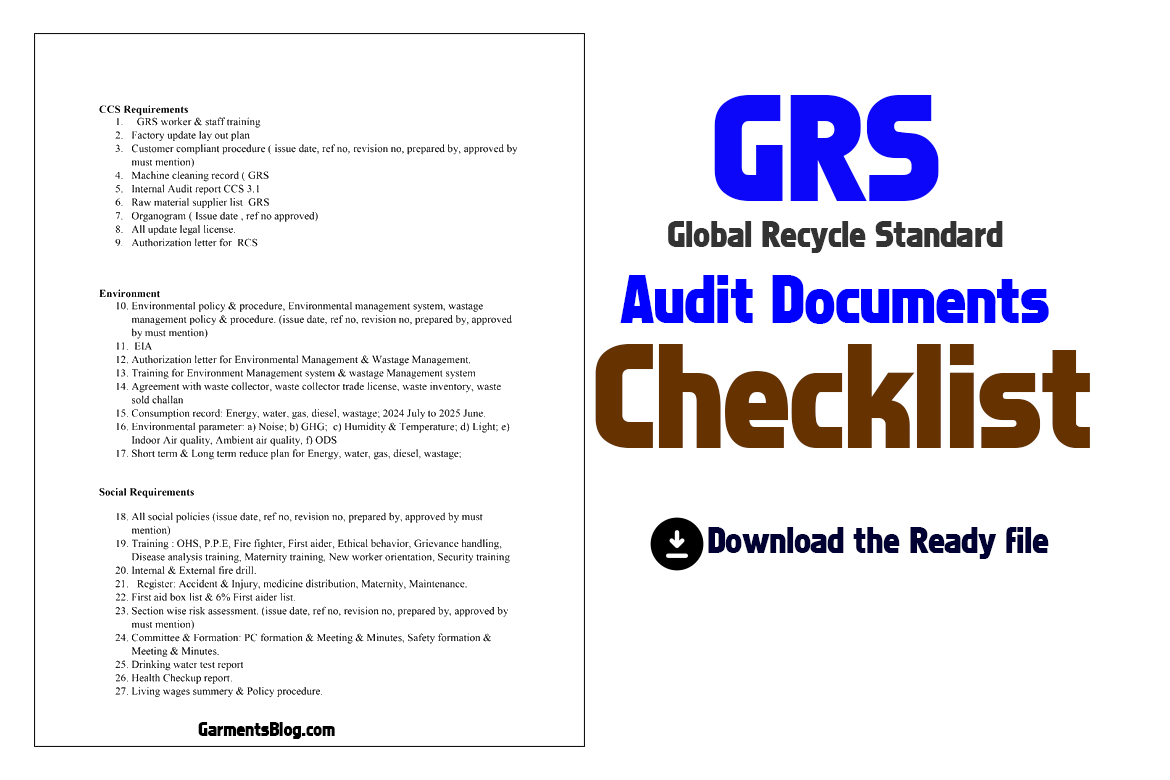
We are sharing detailed guidelines on conducting GRS worker and staff training for audit preparation in garment factories. The goal of Global Recycled Standard (GRS) training is to help both management staff and factory workers understand compliance requirements clearly so they can apply correct practices in daily operations.
Employees at every level must know the GRS rules, understand why material separation matters, and follow proper procedures when handling certified recycled products. If you are preparing your factory for an upcoming audit, make sure to check our complete GRS Audit Checklist for Garment Factories to review all 4 required audit chapters.
The GRS training program should be conducted at two distinct levels:
- Management & Staff Training
- Worker & Operator Training
Both training sessions focus on how GRS certified materials should be received, stored, handled, processed, and shipped. During these sessions, trainers must highlight points that require extra attention, explain special rules that apply during production, and guide everyone on maintaining 100% product traceability.
Management & Staff Training for GRS Audit
Holding a dedicated training meeting with the key management team, departmental heads, and supervisory staff is essential for successful GRS audit preparation. Management must know exactly what GRS is, why it matters, and how it impacts daily production activities.
When the management team understands Global Recycled Standard (GRS) requirements clearly, they can guide production workers effectively, prevent material contamination, maintain proper stock registers, and ensure audit readiness across all departments.
Proper leadership is critical because workers depend on management for daily direction, problem-solving, and compliance reminders. The meeting minutes for management training should focus on the key topics listed below:
- Basic GRS Concepts: Overview of the Global Recycled Standard, its purpose, and business importance.
- Material Care & Handling: Why GRS certified products require dedicated care and strict segregation.
- Production SOPs: Standard operating procedures and rules to follow during GRS production runs.
- Compliance Documentation: How to maintain required audit reports, logs, and verification documents.
- Inventory Control: Maintaining accurate GRS raw material inventory and stock registers.
- Product Traceability: Ensuring end-to-end traceability (input, output, balance) in kilograms (Kgs).
- Risk Management: Identifying contamination risks during production and establishing corrective action plans.
- Roles & Responsibilities: Defining specific duties for warehouse, production, and Quality Assurance (QA) teams.
- SC & TC Certificates: Understanding Scope Certificates (SC) and Transaction Certificates (TC) and their necessity.
- Housekeeping Guidelines: Maintaining strict 5S housekeeping standards on production floors.
A qualified trainer or the factory’s GRS Management Representative (MR) should conduct this training using visual presentations. They will go through every point step by step, answer questions, and clarify what auditors expect during the official audit.
During the session, the trainer will share practical examples demonstrating how to prepare documents, log daily reports, and store GRS goods safely. They will explain how to maintain full traceability from raw material receiving to final garment shipment, including labeling, line segregation, and matching production records with physical stock.
The trainer will also explain how auditors verify product traceability during inspections. This helps management understand which documents will be reviewed, common audit findings, and how to prevent non-conformities.
Worker Training for GRS Audit Preparation
After completing management training, a practical GRS worker training session must be conducted for all operators, helpers, cutting teams, sewing workers, and finishing staff. The objective is to provide workers with a clear, simple understanding of GRS rules and their specific daily responsibilities.
Trainers should use simple language and visual demonstrations so workers grasp concepts easily. The session must cover good housekeeping, material separation, labeling, and how to report errors immediately.
Below are the essential topics to include in the worker training meeting minutes for GRS audit preparation:
- What is GRS: Explaining GRS in simple, practical terms for factory workers.
- Special Handling: Why GRS materials require extra attention and careful handling.
- Material Segregation: Keeping GRS and non-GRS materials completely separate at all times.
- Immediate Reporting: Reporting mix-ups, missing labels, or mistakes to line supervisors right away.
- Clean Workplace: Keeping workstations, cutting tables, and sewing lines clean and organized.
- No Unauthorized Transfers: Never taking or transferring materials from another production line without authorization.
- Regular Training: Participating in regular GRS refresher training sessions and toolbox talks.
Worker training should be practical and hands-on. Using real fabric swatches, color-coded GRS boxes, and physical line tags is far more effective than theoretical explanations. Demonstrating tasks step-by-step ensures operators remember the rules on the shop floor.
Line supervisors and floor in-charges should attend worker training sessions. When supervisors and workers train together, they maintain consistent standards across production lines, ensuring smooth GRS compliance and audit success.
Important Follow-up & Audit Best Practices
The trainer must emphasize why GRS compliance is critical for the factory. GRS guarantees that products contain verified recycled content rather than virgin materials. If GRS material gets mixed with non-GRS material, the entire batch loses its certification status.
To avoid costly non-conformities, all GRS materials must remain clean, properly labeled with “GRS Only” tags, and physically segregated at every stage of manufacturing.
When factory staff and workers follow GRS guidelines accurately, buyers and international brands maintain strong confidence in the factory’s reliability, protecting business orders and worker employment.
Remember, even minor errors—such as a misplaced label or unrecorded material transfer—can result in an audit failure. Audit failures lead to shipment delays, financial penalties, and customer complaints. Proper GRS worker and staff training prevents these risks and ensures a smooth audit experience.
For complete document readiness, refer back to our comprehensive GRS Audit Checklist for Garment Factories to verify your facility is 100% prepared.