Table of Contents
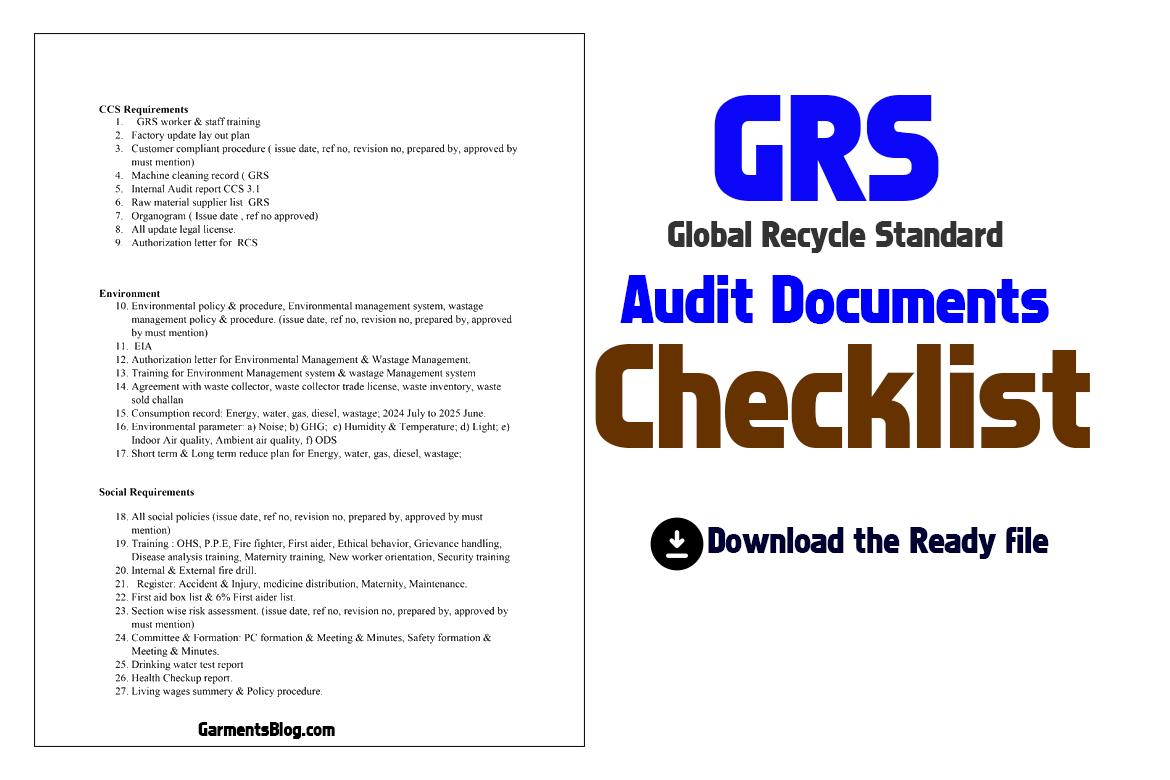
In this blog, I want to share the GRS audit document list that will help you prepare properly and implement all required steps to complete the GRS audit successfully in your garments factory.
I have also attached the full document list below so you can download it and use it directly in your factory.
There are 4 main types of documents required for this audit:
- General Requirements
- Environmental Requirements
- Social Requirements
- Technical Requirements
Below, I will explain each part in more detail so you can clearly understand what documents you need and how to prepare for the audit.
General Requirements of GRS Audit
This section covers the basic requirements needed to understand how well the factory is performing and whether it is truly set up to follow the GRS rules.
Essentially, this is how auditors check: Is the factory and its employees truly prepared for the GRS?
To make sure the audit meets all requirements, there are a few important documents that must be gathered and ready before the audit takes place.
GRS Requirements are below:
- GRS worker & staff training
- Factory update layout plan
- Customer complaint procedure
- Machine cleaning record
- Internal Audit report
- Raw material supplier list GRS
- Organogram
- All updated legal licenses.
- Authorization letter for RCS
These documents are the first and most basic things needed for the audit. They must be shown right at the start.
During every GRS (Global Recycled Standard) Audit, the auditor will first verify these documents. This allows the audit process to officially begin and continue.
Since these documents are standard for anyone handling an audit, we won’t spend time explaining them here. However, we need to focus specifically on the Customer Complaint Procedure and the organogram documents inside.
The factory must have a working system in place to handle any customer complaints. This procedure must follow these rules inside its Standard Operating Procedure (SOP):
Issue Date: This is the date the document was officially started and put into use. Reference Number: A unique document number must be included, which should match the main list in the SOP. Revision Number: This tells us how many times the document has been changed, or which version is currently being used (e.g., Version 1.0, 2.0). Prepared By: The name and job title of the person who created the document must be there. Approved By: The name of the person who officially approved this complaint procedure must be included.
Inside the Organizational Chart (Organogram) Details
The Organizational Chart must also show its Issue Date (when it was first used in the factory). If it has been changed, include the Updated Date or a clear Version Number so it’s easy to track.
Finally, like the procedure above, the chart must clearly name the person who prepared it and the person who approved it.
Environment Requirements of GRS Audit
To secure the Environmental part of the GRS Audit, you must make sure the following documents are fully prepared and updated.
These documents are very important for the auditor because they do two things:
- They prove the factory has official environmental rules in place.
- They show that all staff follow and understand those rules in their daily work.
This demonstrates that the factory is fully committed to environmental protection, which is a key requirement of the GRS standard.
Required Environmental Documents
- Environmental Policy & Procedure, Environmental Management System, and Waste Management Policy & Procedure
- EIA (Environmental Impact Assessment)
- Authorization Letters for Environmental Management & Waste Management
- Training Records for Environmental Management System and Waste Management
- Waste Collector Agreement, Trade License, Waste Inventory, and Waste Sold Challans
- Consumption Records of Energy, Water, Gas, Diesel, and Waste (July 2024 – June 2025)
- Environmental Parameters:
- a) Noise
- b) GHG
- c) Humidity & Temperature
- d) Light
- e) Indoor & Ambient Air Quality
- f) ODS
- Short-Term & Long-Term Reduction Plans for Energy, Water, Gas, Diesel, and Waste
EIA (Environmental Impact Assessment)
A professional study that identifies how the factory’s operations affect the environment.
It evaluates the impact on air, water, and land, and confirms that the factory clearly understands its environmental footprint.
Authorization Letters for Environmental & Waste Management
Official documents that identify the responsible persons who have the authority to manage:
- The Environmental Management System
- The Waste Management Process
These letters show who is accountable for each area.
Waste Collector Documentation
This proves the factory works with legal and approved waste handling partners.
It includes:
- The signed Waste Collector Agreement/Contract
- The waste collector’s Trade License
- Waste Inventory Logs (daily/monthly records of all waste types and quantities)
- Challans/Receipts for waste that was sold or transferred
This ensures transparency in waste disposal.
Consumption Records (July 2024 – June 2025)
A detailed record showing how much the factory used:
- Energy
- Water
- Gas
- Diesel
- Total Waste generated
Auditors check these numbers to confirm the factory is tracking its resource use correctly.
Environmental Parameter Reports
These are test results from accredited labs or internal monitoring.
They verify that the factory meets environmental safety levels for:
- Noise levels
- GHG (Greenhouse Gas emissions)
- Humidity & Temperature
- Light levels
- Indoor & outdoor air quality
- ODS (Ozone Depleting Substances)
Reduction Plans (Short-Term & Long-Term)
These plans show how the factory will reduce its environmental impact over time.
They include measurable goals to lower:
- Energy use
- Water use
- Gas & diesel consumption
- Total waste generation
Short-term plans cover immediate improvements, while long-term plans show the factory’s future roadmap for environmental sustainability.
Social Requirements of GRS Audit
This detailed set of social documents must be presented to the auditor to prove how the factory actively protects the health, safety, and ethical rights of everyone inside the facility. This confirms that the workplace is fair, ethical, and fully follows all rules established for worker well-being.
- All social policies
- Training: OHS, P.P.E, Firefighter, First aider, Ethical behavior, Grievance handling, Disease analysis training, Maternity training, New worker orientation, Security training
- Internal & External fire drill.
- Register: Accident & Injury, medicine distribution, Maternity, Maintenance.
- First aid box list & 6% First aider list.
- Section-wise risk assessment.
- Committee & Formation: PC formation & Meeting & Minutes, Safety formation & Meeting & Minutes.
- Drinking water test report
- Health Checkup report.
- Living wages summary & Policy procedure
- Grievance register, written & Verbal
- Toilet List with checklist.
- P.P.E. Distribution record.
- Personal File: Doctor, Nurse, Electrician, Maternity, PC Vice President.
- Last three months’ Salary Sheet.
- Salary Payment Information Forwarding Letter.
The documents listed in this section are specifically dedicated to fully addressing the social compliance sector of the audit.
The Compliance Team is responsible for presenting these documents to prove that all procedures have been effectively implemented and are actively working inside the factory. This documentation covers every part of the social compliance requirements, ensuring a safe and ethical environment for all workers.
The audit checks all official Policies, detailed Records, required Test Reports, and proof of various Workplace Activities like training and safety drills. This audit even verifies the factory’s commitment to paying workers on time by reviewing the official salary payment information and the forwarding letter associated with those payments to the employees.
Technical Part Requirements of GRS Audit
We need to pay special attention to this paperwork because it gives the auditor solid proof that the certified material (like GRS recycled fiber) was never mixed with any material that is not certified.
The papers create a perfect record that lets the auditor follow the material’s entire trip: from when we bought it from the supplier, through every step of making the product in the factory, until the final item was shipped to the customer.
The required technical documents are given below:
- Traceability documents:
- Purchase documents:
- Commercial Invoice,
- b) Packing list,
- c) BL,
- d) Port challan,
- d) Raw Material payment copy. as like, bill of entry, sales contract, swift copy)
- A ) Production documents:
- a) Store issue ( Yarn + weft);
- b) warping;
- c) weaving;
- d) pretreatment dyeing & finishing
- B) Sales documents –
- a) Commercial Invoice,
- b) Packing list,
- c) BL,
- d) Delivery challan,
- d) Final product payment copy form buyer ( as like, bill of entry, sales contract, swift copy)
- Purchase documents:
- Mass Balance sheet: Raw material TC or PI no, Supplier name, Standard, Purchase quantity, Consumed quantity, Remaining quantity, Final product PI no.
Inside the Traceability documents, these papers help track the certified material through three main steps.
A) Purchase Documents (Buying the Material)
- Commercial Invoice, Packing List, BL: Show what certified material was bought, how much came, and when it arrived.
- Port Challan: Proof that the material was cleared at the port.
- Payment Proof (Swift Copy, Bill of Entry, Sales Contract): Shows the factory paid for the certified material.
B) Production Documents (Making the Product)
- Store Issue (Yarn + Weft): Shows how much certified material was taken from the store.
- Warping, Weaving, Pretreatment, Dyeing, Finishing: Internal records that show the material moving through each production step.
C) Sales Documents (Selling the Product)
- Commercial Invoice, Packing List, BL, Delivery Challan: Show what certified final product was shipped and where it went.
- Payment Proof (Swift Copy, Bill of Entry, Sales Contract): Shows the customer paid for the certified product.
Practical problems and how to fix them in GRS Audits
During GRS audits, I often face two big problems when submitting documents: Product Traceability
Problem in Product Traceability
GRS requires us to show the weight in kilograms (Kgs) for all materials, from the store to the final shipment.
But most factories keep their records in pieces, not in Kgs. They do not have a proper system to track material weight.
So when the auditor asks for a single document in Kgs, we must calculate every piece and convert it into kilograms. This takes time and can cause mistakes.
Every production section must show three things in Kgs:
- Input: How much material the section received.
- Output: How much material the section used or sent to the next section.
- Balance: How much material is still in that section.
Example (Store Section)
The store must show:
- Kgs of fabric received
- Kgs of fabric issued
- Kgs of fabric left in stock
This same format must continue for all other sections like cutting, sewing, and finishing.
How to Fix the Traceability Problem
To get the correct weight (in Kgs) at every step, we need to collect all transfer receipts (challans) used to move goods between sections.
Then follow these steps:
- Match the Numbers: Write down the pieces or Kgs from the transfer receipt. Check this number with the record from the section that sent the goods. Both must match.
- Confirm the Next Section: The amount one section sends must be the same amount the next section receives.
- Repeat for All Sections: Keep checking and matching numbers for every section using the same format (Input, Output, Balance in Kgs).
This process continues until every kilogram matches from the start of production to the end
📝 GRS Global Recycle Standard Audit Documents Checklist Download
To help you understand this process even better and for future reference in your own workplace, I have shared the GRS Global Recycle Checklist documents here.